

You can register your logo in Sri Lanka by filing a trademark application with the National Intellectual Property Office of Sri Lanka (NIPO).
In most cases, a logo is registered as a device mark. A device mark protects the visual appearance of your logo including the design, symbol, stylized letters, image, layout and graphic elements in your logo.
In this guide, we explain how to register a logo in Sri Lanka step-by-step, the difference between brand and logo registration, the difference between a word mark and a device mark, how to choose the correct trademark class, what documents you need, how much logo trademark registration costs, and the common mistakes to avoid before filing your application with the National Intellectual Property Office of Sri Lanka.
Table of Contents
What is logo registration in Sri Lanka?
Logo registration means registering the visual elements of your logo as a trademark with the National Intellectual Property Office of Sri Lanka.
Once your logo is registered, you get legal ownership over that logo for the goods or services covered by the registration.
For example, if you register your clothing store’s logo under Class 25, your protection is mainly for clothing and related goods covered by that class such as footwear and headwear.
It does not automatically protect your logo for online retail services or fabrics, for example, bedspreads, pillow shams, towels of textile .
That is why choosing the correct trademark class is so important. Trademark protection is limited to the class of goods or services covered by your application.
But here is the most important point.
Registering your logo is not the same as registering your brand name. Your brand name is usually registered separately as a word mark. A word mark protects the words themselves regardless of how they are designed or displayed.
Another important point is that trademarks are registered under specific classes.
For example, if you run an online clothing store, and you want to register your brand name and logo for clothing under Class 25 and online retail services under Class 35, you would need to file four separate trademark applications.
Word mark – Class 25
Device mark – Class 25
Word mark – Class 35
Device mark – Class 35
So, if you want to protect your brand name and logo in more than one class, you will need to file separate applications in each class.
This is where most business owners get confused.
They think one trademark registration protects their brand or logo. But it does not.
Logo registration vs brand name registration
Brand name registration and logo registration are different. Your brand name is the word the people use to identify your business. Your logo is the visual design people see.
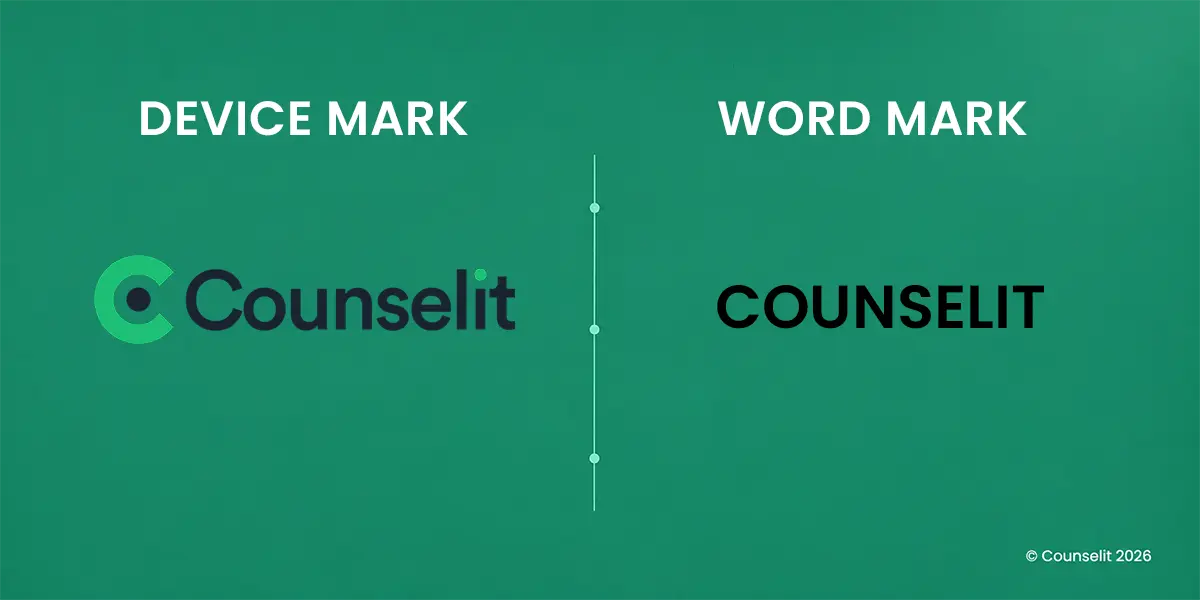
For example, if your brand name is Counselit and your logo includes the C shape icon together with stylized lettering, there are two different elements to protect. Your brand name – Counselit. Your logo, the C shape icon with stylized lettering.
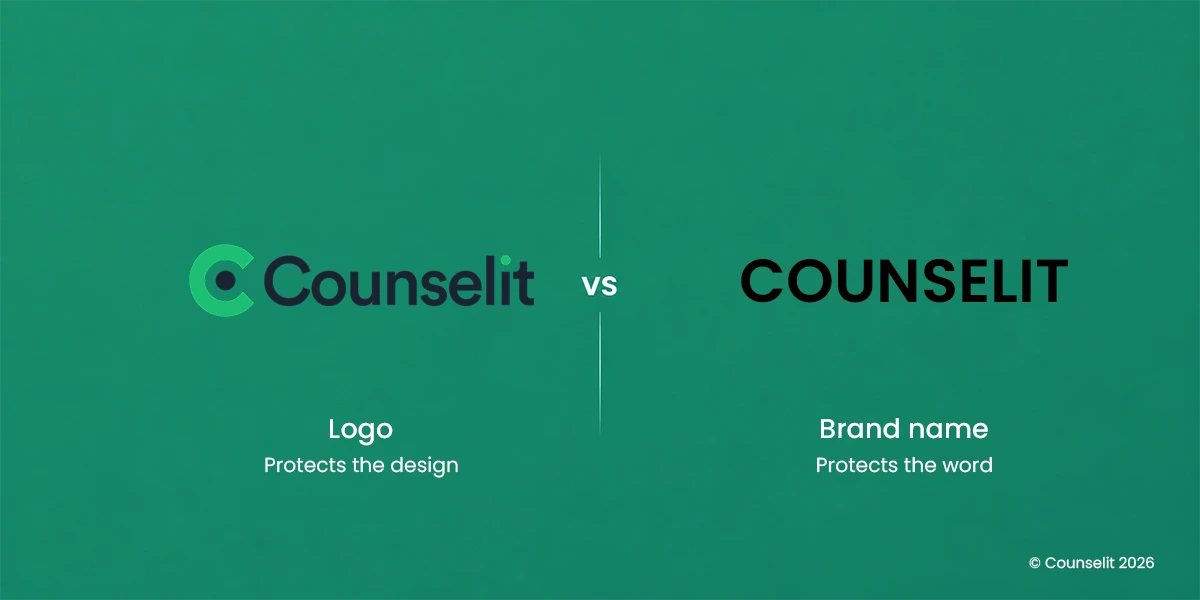
If you register only the logo, your protection is tied to that specific visual design.
If you register only the brand name, your protection is for the word Counselit, not the logo design.
This is why brands often register both the brand name and the logo separately.
What is the difference between a word mark and device mark?
A word mark protects the brand name. A device mark protects the logo.
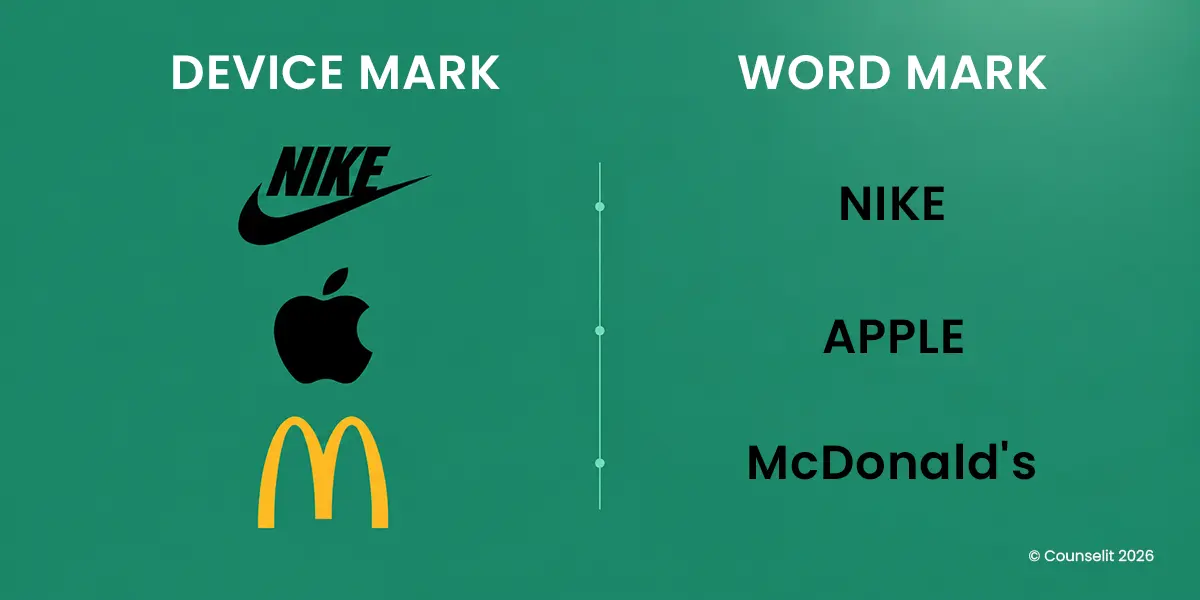
Registering a word mark is useful because it protects the words in plain form. It does not depend on the colour, font, design or layout.
For example, if you register your brand as a word mark, another person cannot easily copy your brand by writing the same or similar brand name in a different font or logo style.
A device mark protects the specific logo design filed with the trademark application.
For example, if you register C-shape logo with stylized letters in a particular design, your protection is for that visual version of the mark. If you change the logo later, the old logo registration will not fully protect the new logo.
Should I register my brand name or logo first?
If your budget allows only one application, we recommend registering the brand name first, in the trademark class that is core to your business.
This is the practical answer for most startups and small businesses. Your logo can change. Your font can change. Your colour palette can change. Your packaging can change. But your brand name is usually the main asset you want to protect.
If someone copies your brand name, it can damage your business more than someone copying an old version of your logo. This is why word mark registration usually comes first.
After the brand name is registered, you can register business logo when the design is final and you know you will continue using it.
When should I register the logo first?
There are some cases where registering business logo is equally important or even more important than registering your brand name.
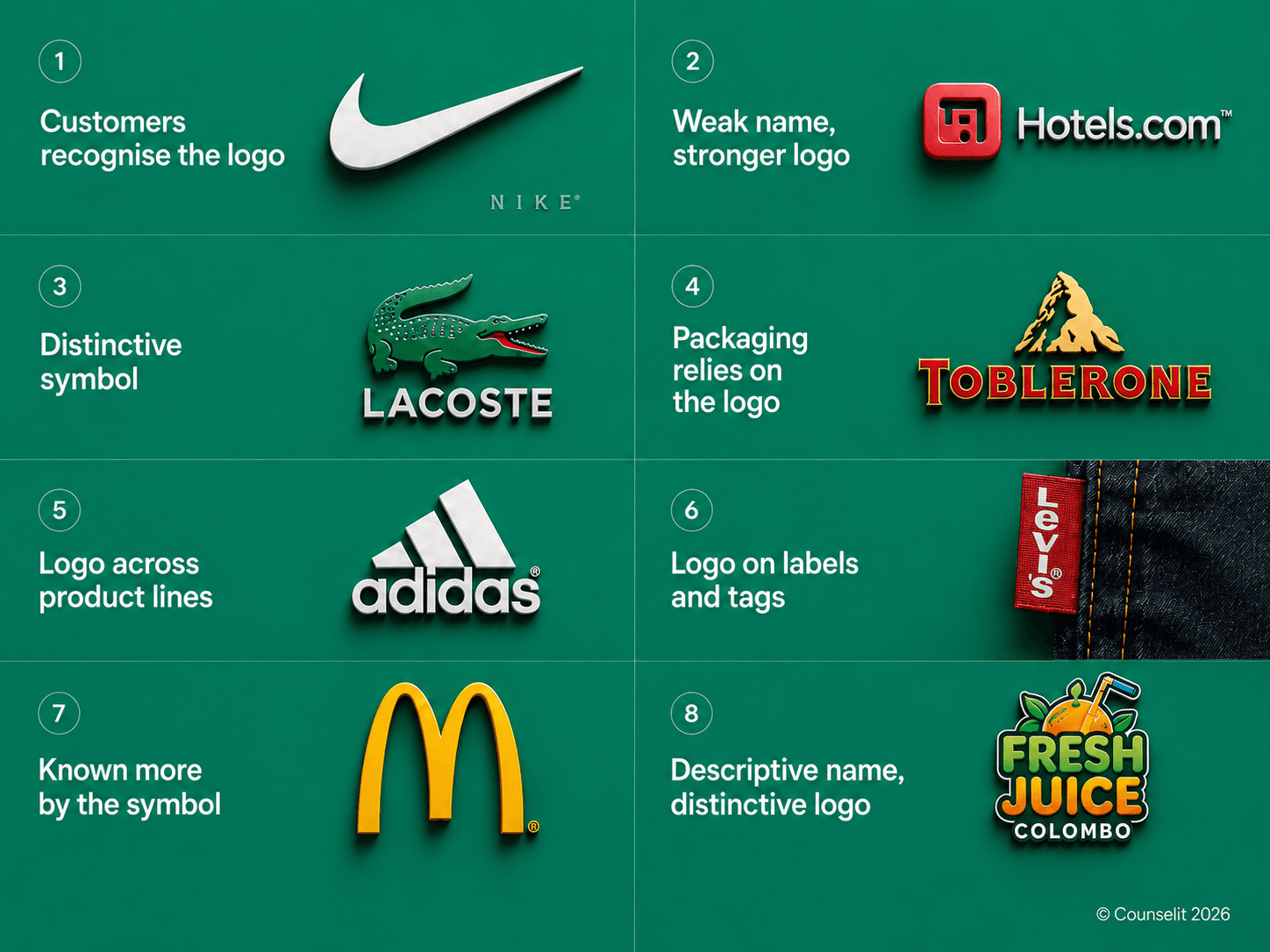
You should register the logo early if:
1. Your logo is the main thing customers recognise.
For example, many people can recognise the Nike Swoosh even without seeing the word “Nike”.
2. Your brand name is descriptive or weak.
For example, a name like Hotels.com is descriptive, so the visual logo and overall brand presentation can become very important.
3. Your logo has a distinctive symbol.
For example, the Lacoste crocodile is a distinctive symbol that people immediately connect with the brand.
4. Your packaging depends heavily on the logo.
For example, Toblerone’s packaging and logo are strongly connected to how customers recognise the product on a shelf.
5. You sell fashion, cosmetics, food, beverages or lifestyle products.
The Adidas three stripes are often displayed directly on clothing, shoes and lifestyle products.
6. Your logo appears on labels, tags, bottles, boxes, menus, uniforms or products.
For example, Levi’s red tab appears directly on the product and helps customers recognise the brand.
7. Your business is already known by the logo more than the name.
For example, McDonald’s Golden Arches are so well known that many customers recognise the brand even without reading the name.
8. Your brand name is difficult to register because it is descriptive, a distinctive logo can sometimes give stronger protection.
If your brand name is “Fresh Juice Colombo”, the words are weak because they merely describe what the goods actually are. NIPO can refuse to register your brand name because it is merely descriptive.
But if the logo has a unique fruit character, shape, symbol or layout, you can still file your logo as a device mark which can be useful.
How to register a logo in Sri Lanka?
Here’s how to register a logo in Sri Lanka.
1. Finalize the logo before filing.
Before filing, make sure your logo is final.
Do not file a draft logo.
Do not file a logo you are planning to redesign in two months or you are still working with a designer on the final brand identity.
A logo trademark protects the design you file. If you change the logo later, the old registration will not automatically protect the new design. If the new logo looks different from the filed logo, you should file a new application.
2. Check whether the logo is distinctive.
Your logo should be distinctive. This means it should help customers identify your business and separate it from competitors. A simple generic icon is weak.
For example, a plain coffee cup for a café is weak.
A plain house icon for a real estate business is weak.
A plain leaf icon for an organic product is weak.
A plain scale icon for a legal service is weak.
These symbols are already used by many businesses.
If your logo uses a common industry symbol, make it more distinctive with a unique design, word element, arrangement, colour combination or overall visual impression.
Do not copy the style of another brand.
Do not use a logo that looks like a famous brand.
Do not use a logo downloaded from a free logo website unless you are sure you have proper rights to use it.
3. Select the correct trademark class.
Sri Lanka does not allow one multi-class application. You should file a separate application for each class.
Therefore, before filing your logo application, you must select the correct trademark class based on the goods or services you offer.
For example
- Clothing – Class 25
- Cosmetics – Class 3
- Food products – Class 29 or Class 30 depending on the product
- Restaurant services – Class 43
- Retail store services – Class 35
- Software – Class 9 or Class 42 depending on the product or service
- Education services – Class 41
- Legal services – Class 45
If you register your logo in the wrong class, your protection will not properly cover your business.
This is one of the most expensive mistakes business owners make in trademark filing.
4. Do a trademark search for similar logos.
Before filing the logo, be sure to do a trademark search.
A logo search is different from a simple brand name search. You should check:
- Similar words featured in the logo
- Similar pronunciation
- Similar logo symbols
- Similar visual style
- Similar layout
- Similar meaning
- Similar brands in the same class
- Similar brands in related classes
- Common law brands already used online
For logo registration, visual similarity is very important. Keep in mind that two logos do not have to be identical to create a problem. If the overall commercial impression is too close, NIPO can raise an objection to register your logo.
For example, if your logo uses a similar animal, similar shape, similar colour layout and similar font style to another brand in the same industry, changing one small part will not make your logo distinctive enough to register as a trademark.
5. Prepare the trademark application.
Your logo should be submitted as a clear representation of the mark. If the logo has small distinctive elements, please ensure that the copy of the logo is large and clear enough for those elements to be visible. For logos with complex designs, we recommend submitting a 10 cm × 10 cm copy of the logo.
If the logo contains words in a language other than Sinhala, Tamil or English, prepare a certified translation.
If you are filing through a registered IP agent, sign a Power of Attorney to authorize your agent. If the applicant is a company, use the company name exactly as stated in the Certificate of Incorporation. If the applicant is an individual, use the name exactly as stated in the NIC or passport.
6. File the logo trademark application with NIPO.
Once the application is ready, file the logo trademark application with NIPO Sri Lanka.
After you submit your application to NIPO, you will receive an acknowledgement copy of your application with an acknowledgement number. Keep this acknowledgement safely, as you will need it to follow up on your application.
The application will then go through examination, which usually takes around 5–7 months.
If NIPO accepts the application, you or your trademark agent will receive an acceptance letter for publication in the Gazette. After you apply for publication and pay the publication fees, the logo will be published in the Gazette.
If no opposition is filed within the 3-month opposition period, you can apply for the trademark certificate by submitting a copy of the Gazette.
7. Follow up with NIPO on trademark examination, publication and registration
Filing the trademark application is not the end of the process. The trademark registration process typically takes 12–18 months to complete.
You should follow up until the mark is examined, accepted, published and registered.
If NIPO issues an objection or if someone opposes your logo after publication, you should respond within the given time. If you miss deadlines, your application will be considered as abandoned.
8. Use TM symbol with your registered logo trademark
Once your logo is registered as a trademark in Sri Lanka, you can use the ® symbol alongside your logo. See the example below.

Documents required to register a logo in Sri Lanka
To apply for logo trademark in Sri Lanka, you need the following documents.
- High-quality image of the logo (less than 10 cm × 10 cm)
- List of goods or services
- Trademark class
- NIC or passport copy for individual applicant
- Business registration certificate for sole proprietor or partnership, certificate of incorporation for company applicant
- Duly signed Power of Attorney, if filing through a registered IP agent
- Certified translation, if the logo contains non-Sinhala, non-Tamil or non-English words
- Priority document, if claiming priority from an earlier foreign application
If you are a foreign applicant, you will need to file logo registration through a registered IP agent in Sri Lanka.
Common mistakes when registering a logo
The biggest mistake business owners make in registering their logo is thinking that one logo registration application protects your brand entirely.
However, one logo registration application only protects the brand only in the particular trademark class.
Here are some of the most common mistakes many business owners make in filing their logo as a trademark.
- Registering only the logo and forgetting the brand name.
- Filing the logo before the design is final.
- Selecting the wrong trademark class.
- Using a generic industry symbol.
- Copying the style of a famous brand.
- Filing in one class when the business operates in several classes.
- Using the company name as applicant when the brand is owned personally.
- Using personal name as applicant when the brand belongs to the company.
- Not doing a logo search.
- Not checking common law brands.
- Missing NIPO deadlines after filing.
Practical filing tips for startups
If you are just starting your business, do not file in every class blindly.
First, identify your main business activity.
Next, select the most important trademark class.
Then file the brand name as a word mark in that class.
After that, file the logo as a device mark if the design is final and you are using it on products, packaging, social media, website, labels, invoices or shop signage.
If your budget allows both, file both the word mark and device mark at the same time. If your budget allows only one, file the word mark first unless the logo is the main identity of the brand.
This gives you stronger practical protection for the money you spend.
How much does it cost to register a logo in Sri Lanka?
Logo registration fees depend on whether you are filing as an individual or entity, number of trademark classes, number of words in list of goods and services, size of the logo and professional fee if you retain a registered IP agent. Company logo registration costs more than individual logo registration.
If you register only brand name in one class, you pay for one application.
If you register only one logo in one class, you pay for one application.
If you register the brand name and logo in one class, you pay for two applications.
If you register the brand name and logo in two classes, you pay for four applications.
This is why you should decide the filing strategy before submitting the application.
Avoid spending on classes that are only distantly relevant at the beginning. Start with the class that covers your main source of revenue. You can always file additional classes later as your business grows.
Need help registering your logo or brand name in Sri Lanka?
Your logo is more than just a design. It is one of the main ways customers recognise and remember your business.
If you are not sure whether to register your brand name or logo, or both, we can help you decide the best legal strategy to protect your brand from the beginning.
At Counselit, our registered IP Agents assist local and foreign businesses with logo trademark registration in Sri Lanka, by helping you choose the right trademark classes, conduct logo searches, prepare trademark applications, and guide you through the brand and logo registration process.
Ready to get started? Book a complimentary 15-minute consultation today or contact us at +94760011066.