
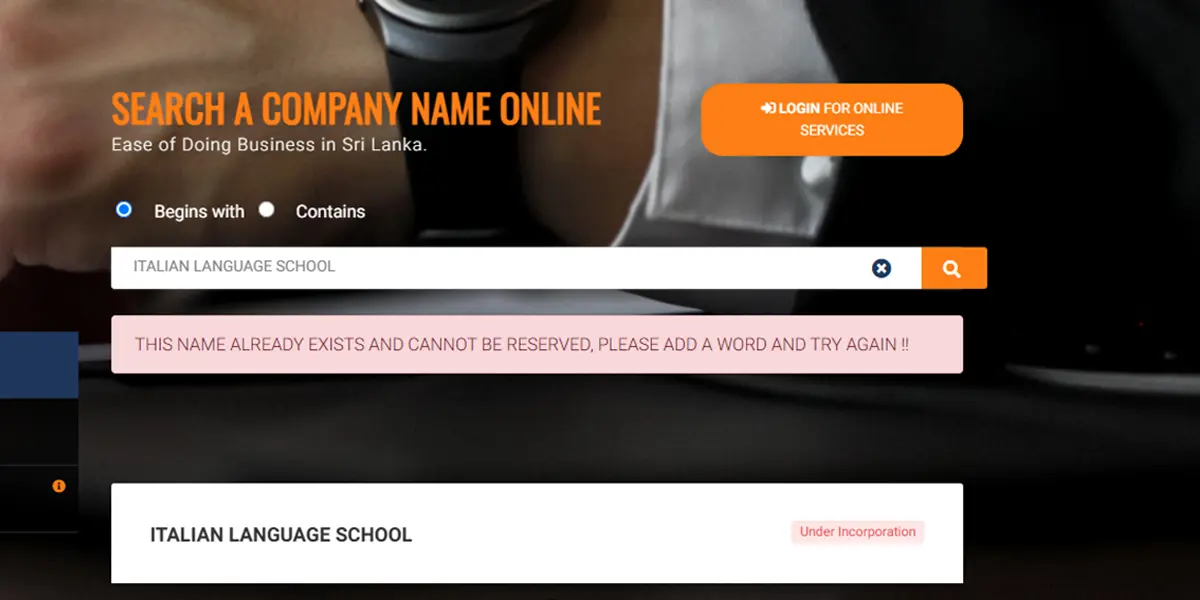
You can quickly check if a company is legally registered in Sri Lanka by searching its name on the Department of the Registrar of Companies’ official eROC portal.
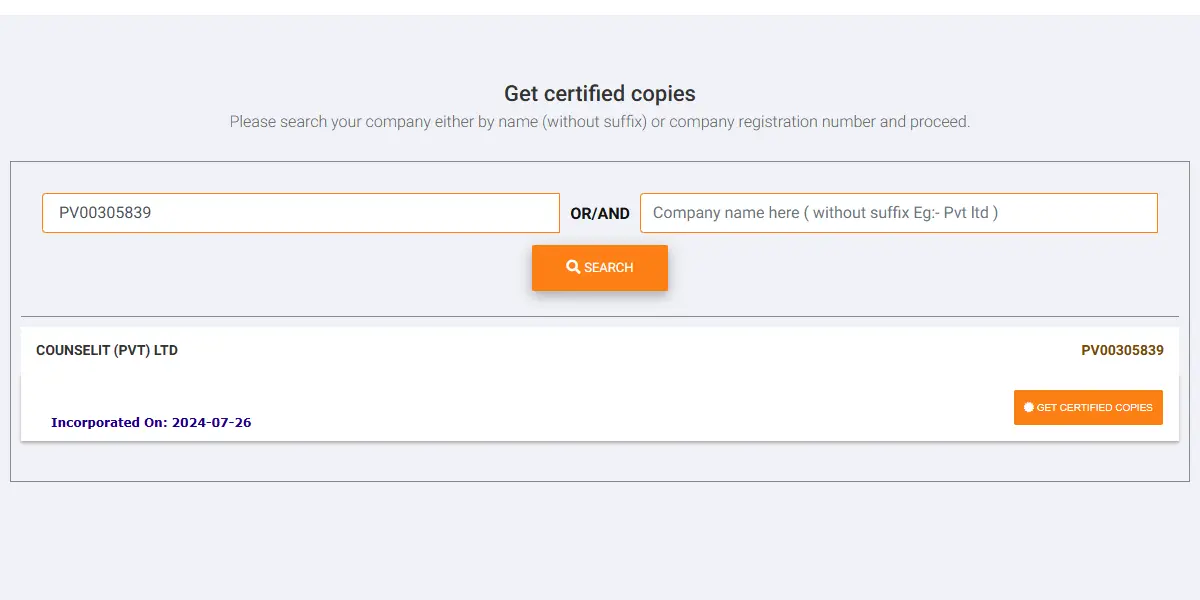
If the company is registered, the eROC name search will show the company name with its registration number.
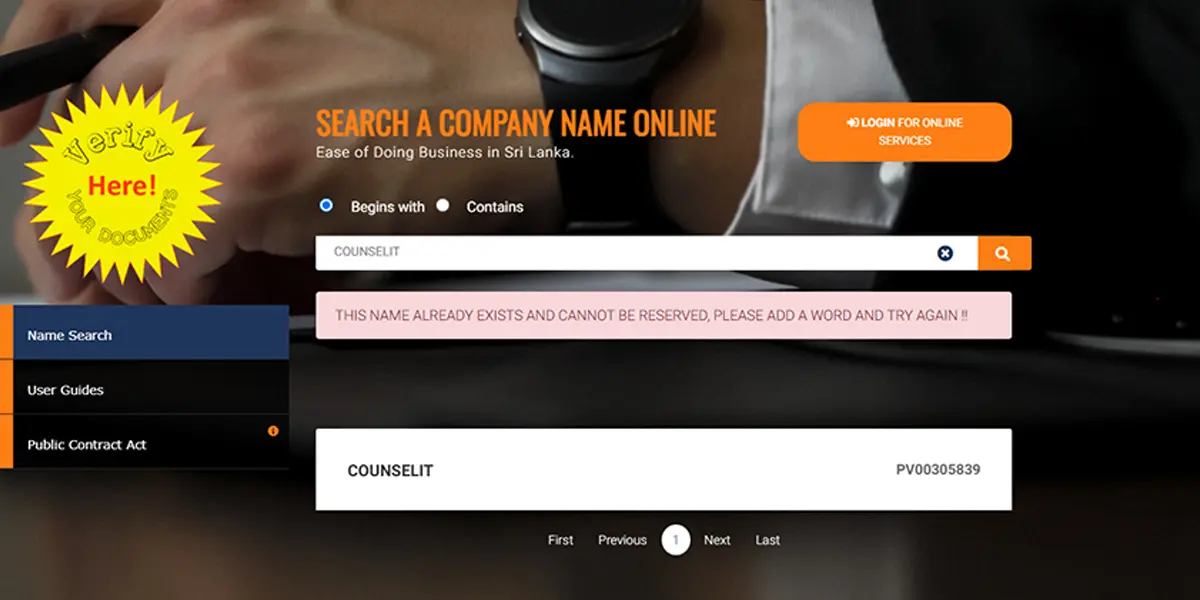
For companies that have reserved its name but are still pending incorporation, the search will show the status as ‘Under Incorporation’.
In this blog, we will show you exactly how to check if a company is legally registered in Sri Lanka in 5 simple steps.
Table of Contents
How can I check if a company is registered in Sri Lanka?
There are two main methods to check if a company is registered in Sri Lanka.
1. eROC name search
To check if a company is registered, go to eROC website and search the company name. You do not need an eroc account to do a name search. Name search is available on eroc website home page.
You also do not need the company registration number to start the search. The company name is enough.
If an identical or similar name appears in the search results, you can see the registered company name and company registration number.
For example, if someone tells you they are “ABC Holdings (Private) Limited”, you can search “ABC Holdings” on name search bar on eroc website home page.
If the company is registered, eROC will show the company name and registration number.
If nothing appears, there is no company registered under the name.
Do not rely on WhatsApp profiles, invoices, letterheads or social media pages alone. Always check the company name through eROC to confirm whether the company is registered.
2. Check ROC-certified copies
eROC name search is the quickest way to verify whether a company legally exists in Sri Lanka, but it is only the first step.
If you are conducting due diligence before signing a contract, making a payment, hiring a supplier, or investing in a Sri Lankan business, a basic name search will only give you the company’s name and registration number.
To check company stakeholders, the registered address, and filing compliance, you can order certified copies of company documents directly from your eROC dashboard if you already have an account. If you don’t have an account yet, you will need to register one first.
Certified copies will help you find who the company directors, shareholders, and secretary are, along with their NIC or passport numbers and residential addresses. You can also confirm whether the company has filed its latest annual return, any recent appointments or removals of directors or secretaries, and the company’s registered office address.
What information do you need before checking a company?
Having company name is enough to check if a company by that name is registered in Sri Lanka.
For proper due diligence before signing a contract or lease, a name search is clearly not enough. You must verify the company’s registered address, directors, and shareholders using official eROC certified copies. This includes Form 01, the latest annual return, the Articles of Association, and Form 20 or Form 13 if there have been any changes to the board, secretary, or registered address.
Additionally, when dealing with an individual who is not a director, you should always request written authorization (such as a signed board resolution) granting them the authority to act on the company’s behalf.
How to verify If a company is registered in 5 steps
Step 1: Search the company name on eROC
Seach ‘eROC Sri Lanka’ on Google and visit the eROC official website home page.
Use the company name search option and type the company name on the search bar.
Do not include company suffixes such as ‘Private Limited’, ‘Pvt Ltd’ or ‘Guarantee Limited’.
For example, if the company name is “Ceylon Green Foods (Private) Limited”, search ‘Ceylon Green Foods’.
If a company exists, the search result will show the company name and registration number.
Step 2: Check the company registration number
Once the company name appears, you will see the company registration number right alongside it.
Private companies incorporated in Sri Lanka have a registration number starting with PV followed by numbers, for example, PV00234567.
Older companies can have shorter number formats.
Do not reject a company only because the registration number looks different. Some older companies were registered before the current numbering format.
But always compare the company number with the certified copies of eroc forms given to you.
If a draft agreement or tax invoice says one registration number and eROC shows another number for the same company name, ask for clarification before moving forward.
Step 3: Check whether the name is identical or similar
eROC often returns multiple search results with similar company names, but a similar name does not mean it is the company you are looking for.
For instance, the following company names are distinct legal entities.
- ABC Trading (Private) Limited
- ABC Traders (Private) Limited
- ABC International Trading (Private) Limited
- ABC Trading Lanka (Private) Limited
Do not assume they are connected. The Registrar of Companies database contains thousands of entities with similar names. For proper due diligence, you must always verify that both the exact company name and the exact registration number match.
Step 4: Create an eROC account
A basic name search is sufficient if you only need to confirm that a company is registered in Sri Lanka.
However, to access certified copies of official company documents, you must create an eROC account first. Once your account is set up, verify the account and log in to your dashboard.
Step 5: Apply for certified copies from ROC
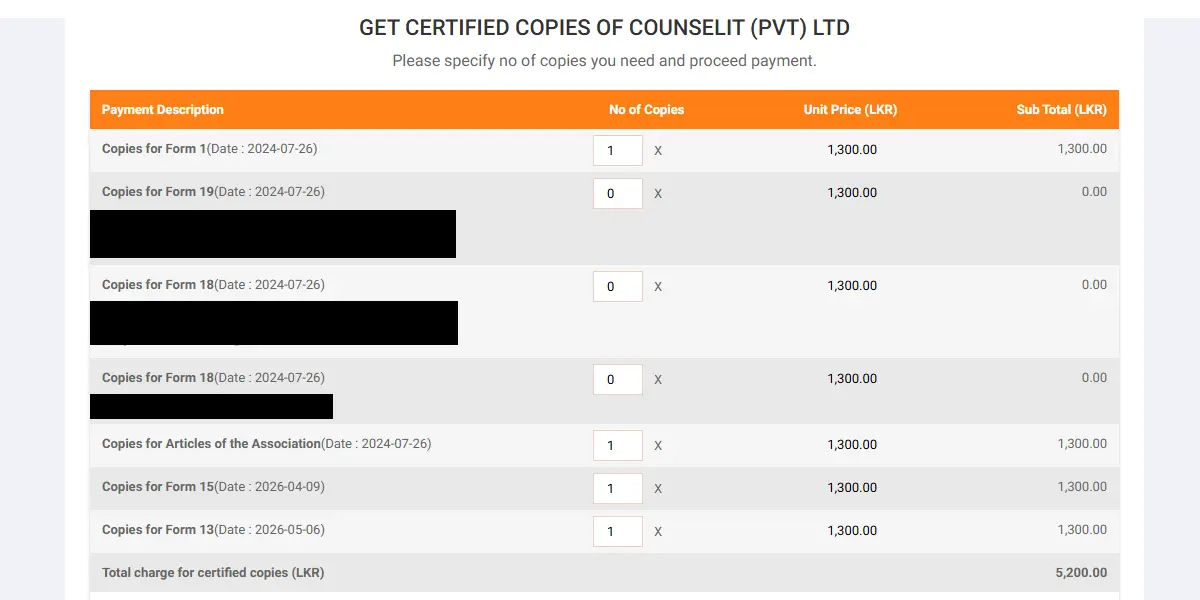
Once you log into eROC dashboard, apply for certified copies of the documents you need using the company’s name or registration number.
Certified copies are official legal documents issued directly by the Department of the Registrar of Companies (ROC) in Sri Lanka.
You should always request certified copies when conducting serious due diligence, particularly if you are
- Signing a major commercial contract or lease agreement
- Paying an advance or security deposit
- Appointing a new distributor or agent
- Onboarding a key supplier
- Lending money or extending commercial credit
- Entering into a joint venture partnership
- Purchasing shares or investing in the business
- Verifying a foreign investor’s local Sri Lankan entity
- Confirming whether a signing director possesses proper authority
- Verifying that the individual you are negotiating with is officially recognized by the company.
Do not rely only on copies sent by the signing-parties. They can send you outdated or incomplete documents.
A certified copy from ROC gives you the latest official information of the company filed with the Registrar.
Which company documents should you request?
For basic due diligence, you can request the following documents.
- Latest Annual Return
- Form 01
- Articles of Association
- Form 20, if directors or secretary changed
- Form 13, if registered office changed
- Form 15, if checking latest annual return details
- Form 6 or share-related forms, if you are checking stated capital or share changes
You do not need every document for every matter.
The right document depends on what you want to check.
Which company document to request first?
- For companies older than 18 months, request the latest Annual Return (Form 15) first. This provides the most recent official overview of the company’s ownership and management structure. If there have been recent chages to the company’s address or directors after the latest annual return date, request for certified copies of Form 20 or Form 13 as applicable.
- For newly incorporated companies (under 18 months), request Form 01 and the Articles of Association.
What does eROC Form 01 show?
Form 01 is the application form for incorporating a company under the Companies Act No. 7 of 2007. This is the most important document for newly registered companies. In fact, banks will always ask for a certified copy of Form 01 when opening a corporate bank account.
Form 01 shows the initial details of the company at the time of incorporation.
This includes:
- Company name
- Company Name Reservation number
- Registered office address
- Initial directors, their NIC/Passport number, email and signatures
- Initial secretary, RCS registration number (if a Registered Company Secretary), their NIC/Passpor number, email, and signature
- Initial shareholders, their NIC/Passport number, and signatures
- Number of shares owned by each shareholder
- Initial share capital
If a company is newly incorporated, Form 01 is the main document you should check. For example, if a company was registered just three months ago, it will not have filed an annual return yet. In that case, Form 01 is the primary official record that proves who the initial directors, shareholders, and corporate representatives actually are.
What does the Annual Return show?
The Annual Return is the document you should check if the company has been operating for some time.
Any company older than 18 months is required to file an Annual Return every year. If the company is more than 18 months, you should always check its latest Annual Return to get an accurate snapshot of the company as of the annual return date.
The Annual Return has nearly all major company details, and any changes made to the company over the preceding 12 months, including:
- Company name
- Company registration number
- Existing Registered office address, change of registered office address (if any)
- Directors, adding or removal of directors (if any)
- Secretary, change of secretary (if any)
- Shareholders, share transfers (if any)
- Shareholding details
- Stated capital, calls on shares, any unpaid share capital
- Auditor name and address
For due diligence, the latest Annual Return is far more comprehensive than Form 01 for an older company.
This is because Form 01 only shows the details at the stage of incorporation. The company may have later changed directors, shareholders, secretary or registered office after incorporation.
What do the Articles of Association show?
The Articles of Association are the internal rules of the company.
They define how the company is governed and the powers of directors.
You can check the Articles to know:
- How directors are appointed/removed
- How shares are transferred
- Whether there are restrictions on share transfers
- How many directors should sign to pass a board resolution
- Who can sign on behalf of the company when signing a contract
- Whether shareholder approval is needed for certain transactions
- Whether the company has special rules different from model articles or relies on standard model articles under the Companies Act.
Never ignore the Articles when enering into serious business deals.
For example, if you are buying shares in a private company, the Articles can often contain restrictions on share transfers. Reviewing these clauses upfront ensures you understand your exit options and transfer rights.
If you are executing a lease, distribution agreement, or trademark license, checking the Articles confirms whether a single director’s signature is legally binding or if a formal board resolution and common seal are required.
When should you request Form 01 instead of Annual Return?
You should request Form 01 instead of an Annual Return if the company is newly incorporated or less than 18 months old. This is because a new company is not required to file its first Annual Return immediately after incorporation.
For a company under 18 months old, Form 01 and the Articles of Association are the two primary documents you must check for proper due diligence.
However, for a company that has been in business for more than 18 months, relying on Form 01 alone is not enough. Over time, the company may have updated its directors, shareholders, secretary, registered office address, or stated capital. To get an accurate, up-to-date picture of an older entity, you should always request a certified copy of its latest Annual Return instead.
What should you check before signing a contract with a company?
Before signing a contract with a company, do proper due diligence to ensure the contract is legally binding and enforceable.
- Exact legal name
- Company registration number
- Current registered office address
- Latest directors
- Company secretary
- Latest shareholders
- Whether the person signing is a director or authorized signatory
- Signing authority
- Whether board approval is needed
- Whether the company has filed annual returns
- Whether the company name on the contract matches ROC records
- Whether the bank account name matches the company name
- Whether the invoice name matches the registered company name
- Whether the company is using a trading name different from its registered name
For example, if the contract lists an informal trade name such as “ABC Trading” but ROC records show “ABC Trading (Private) Limited”, you must use the full registered legal name in the agreement.
Never execute a contract where parties are listed under an informal business name. The correct party to the contract should be the registered legal entity with the full form of its legal name, registration number and registered address. The natural person who signs on behalf of the company must also have proper legal authority to bind the company.
For example, if you are signing a service agreement with “Colombo Tech Services (Private) Limited”, first search the company name on eROC Sri Lanka home page and confirm the company registration number.
Then apply for a certified copy of Form 01 or the latest annual return (if available) through your eroc account dashboard.
Check that the person signing the contract is listed as a director. Cross-reference their NIC or Passport number, residential address, and email using the official eROC filings.
If the person signing the contract is not a director, you must request a secretary-certified board resolution authorizing such person to enter into the transaction on behalf of the company.
Where a director signs a contract on behalf of the company, verify the number of directors required to sign to validly bind the company to the contract. Depending on the company’s Articles of Association, a single director may not always have the authority to execute the contract or affix the company seal on behalf of the company.
Do not assume that a sales manager, consultant or employee can bind the company.
Common mistakes when checking if a company legally exists
Many people make these common mistakes when checking a company’s registration status as a legal entity.
- Searching only Google
- Relying on a business card
- Relying on a Facebook page or social media handles
- Relying on a logo or letterhead
- Not checking the registration number
- Not checking the exact company name
- Confuse with misleading similar company names
- Not requesting certified copies of the company’s official documents
- Using Form 01 for an old company without checking latest annual return
- Not checking whether the signing person is a director
- Not checking whether the bank account belongs to the company
- Not checking whether the company has changed its registered office
- Not checking whether the person you deal with has written authority from the company through Articles or a board resolution
The single biggest mistake is assuming that a registered company is automatically safe to deal with. Company registration only confirms legal existence. It is not a guarantee of creditworthiness or trustworthiness.
Company registration only confirms legal existence. It does not confirm financial standing, tax compliance or past litigation or pending court cases.
An active registration does not mean a company can legally enter into any type of business deal. The Articles of Association define the company’s scope of business. For example, a foreign-owned company permitted to import and wholesale computers cannot do retail sales without Board of Investment (BOI) registration.
It does not automatically grant the individual you’re dealing with the legal authority to sign contracts on the company’s behalf.
Proper due diligence means looking beyond basic registration. Always check official ROC documents, review internal company rules, and verify who has the authority to sign before closing any deal.
FAQs
How to find if a company is registered in Sri Lanka?
Search the company name on the eROC portal of the Department of the Registrar of Companies. If the company is registered, the search result will show the company name and company registration number.
Can I check a Sri Lankan company using only the company name?
Yes, a company name is sufficient to run a free public search on eROC. However, for full due diligence, you must cross-reference the company’s registration number and certified copies of their official documents.
Where can I find a Sri Lanka company registration number?
You can find the registration number of a Sri Lankan company using the eROC online name search. You can also find it on their Certificate of Incorporation, latest Annual Return, and other official eROC forms.
Is eROC company name search enough for due diligence?
No. An eROC name search only confirms that a legal entity and registration number exist in the database. For proper due diligence, obtain certified copies of the company’s Form 01, Articles of Association, latest Annual Return, and recent change forms (Form 20, Form 13).
How do I check the directors of a Sri Lankan company?
To check a company’s board of directors, log into your eROC account dashboard and request a certified copy of the company’s latest Annual Return (Form 15). For companies under 18 months old that haven’t filed an annual return, request Form 01. If directors changed after incorporation, you can request a certified copy of Form 20.
How do I check the shareholders of a Sri Lankan company?
Request a certified copy of the latest Annual Return (Form 15) via the eROC dashboard. The annual return lists all shareholders as of the filing date, including their NIC or Passport numbers, addresses, and share allocations. For newly incorporated companies, check Form 01.
How do I check the company secretary of a Sri Lankan company?
The company secretary’s name, address, and registration details are listed on Form 01 (for new companies) or the latest Annual Return (Form 15). If the secretary changed after incorporation, request a certified copy of Form 20 from eROC.
Can anyone obtain certified copies of company documents in Sri Lanka?
Yes. Documents filed with the Department of the Registrar of Companies are public records. Anyone can register an eROC account, search for a company, and request certified copies of official filings through their dashboard.
Are ROC certified copies issued online?
Yes. The Department of the Registrar of Companies issues certified copies digitally. Approved documents feature official verification links and a QR code to validate their authenticity online.
Can I check whether a company is active?
Yes, the basic eROC registry confirms if a company is active and registered. If a company has not filed its annual returns, it can very well suggest the company may be dormant, but failing to file returns does not automatically strip a company of its legal status.
What document should I request for a company?
For companies older than 18 months, request the latest Annual Return (Form 15) to get an up-to-date snapshot of directors, shareholders, and addresses. For companies under 18 months old, request Form 01 and the Articles of Association.
Need help checking a company in Sri Lanka?
Have questions or need support to check if a company is registered? Call us at +94760011066, email us at contact@counselit.com, or book a call with our team today.